Termites · Reticulitermes spp. (mainly R. flavipes)
Subterranean termites
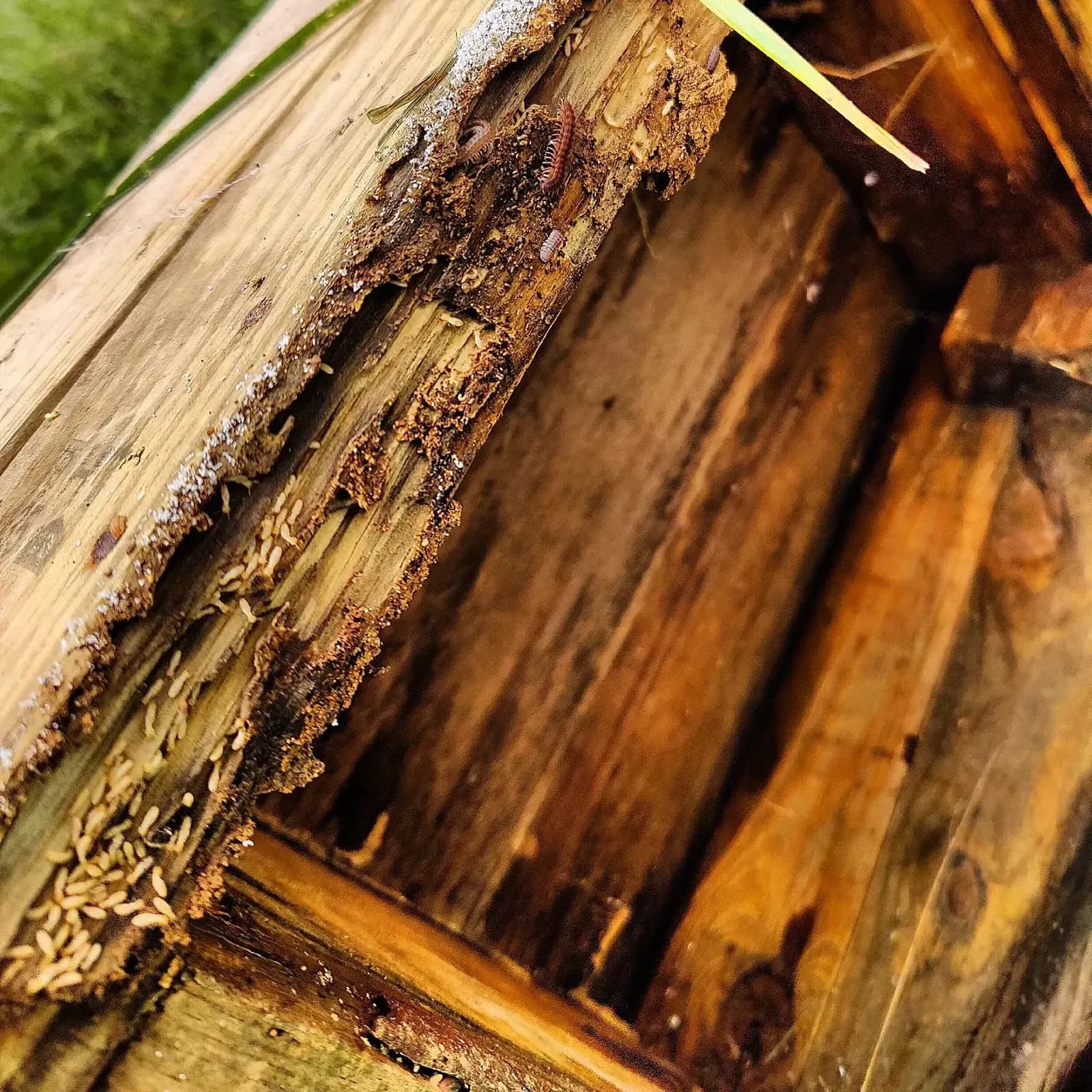
Subterranean termites are soil-dwelling insects that feed on wood and other cellulose, and they are the most destructive wood pest in Tennessee. They don't bite or spread disease, but colonies can damage a home for years before anyone notices. They are common throughout Southeast Tennessee and North Georgia, with swarms peaking in spring.
Seasonal activity
When they're active in Southeast Tennessee
Warm spring rains trigger termite swarms, often the first sign of a colony nearby.
- January: Low
- February: Low
- March: Peak
- April: Peak
- May: Peak
- June: Moderate
- July: Moderate
- August: Moderate
- September: Moderate
- October: Low
- November: Low
- December: Low
Signs you have them
- Swarms of small winged insects indoors, often near windows, doors or light fixtures in spring
- Piles of discarded wings on sills, floors or in spider webs
- Pencil-width mud tubes running up foundation walls, piers or crawl space framing
- Wood that sounds hollow when tapped or lets a screwdriver tip sink in easily
- Dried soil packed inside damaged wood, which separates termite damage from plain rot
- Bubbling or rippled paint and sagging trim near the floor
Termite swarmer or flying ant?
Both swarm in spring and both have wings, so they get mixed up all the time. Three quick checks settle it.
Waist
A termite's body is thick from front to back with no pinch in the middle. An ant has a narrow, wasp-like waist.
Antennae
Termite antennae are straight and look like a string of tiny beads. Ant antennae bend at a sharp elbow.
Wings
Termites have four wings of the same length that extend well past the body and break off easily. Ants have longer front wings than back wings.
Why they're a problem here
Tennessee sits squarely in subterranean termite country. University of Tennessee entomologists list the eastern subterranean termite as the most common species in the state, alongside the dark southern and light southern subterranean termites. That means swarms can show up across a long stretch of the year: eastern subterranean termites usually fly in April and May (earlier on warm late-winter days), the dark southern species around June, and the orange-brown light southern species from July into September.
Our humid summers, clay soils and the crawl space foundations common in older homes around Cleveland, Chattanooga and North Georgia give termites the steady moisture they need. Damage is slow and hidden. It often takes several years of feeding before it shows, which is why routine inspections matter more than waiting to see a swarm.
Formosan subterranean termites, a more aggressive invasive species, have only been reported a handful of times in West Tennessee and are not known to be established in our area. Native termites are the ones doing the damage here.
How we treat them
Every home is built differently, so treatment starts with a careful look at how termites are getting in.
- 01
Inspect
We check the foundation, crawl space, slab edges, porches and garage for mud tubes, damaged wood, moisture problems and wood-to-soil contact, then explain what we found.
- 02
Choose a method
Most homes get a liquid termiticide applied to the soil around and under the foundation to form a continuous treated zone, a bait station system that colonies feed on and share, or a combination. We'll explain why one fits your house better than the other.
- 03
Fix conducive conditions
Treatment lasts longer when moisture, wood debris and soil contact are corrected. We point out what to change, and crawl space moisture work can be part of the plan.
- 04
Monitor
Termite protection isn't one-and-done. Follow-up inspections or bait station checks catch new activity before it turns into damage.
Prevention
What you can do today
- Keep gutters clean and downspouts pointed away from the foundation so soil next to the house stays dry
- Fix plumbing leaks, AC condensate drips and standing water in the crawl space
- Break wood-to-soil contact at steps, deck posts, lattice and siding
- Keep mulch thin and pulled back several inches from the foundation and siding
- Store firewood, lumber and cardboard away from the house and off the ground
- Trim shrubs back from the walls so air can move and you can see the foundation
- Have the home inspected periodically, especially if it has a crawl space or slab additions
When to call us
Termite control
Inspections, liquid and foam treatments, bait stations and exclusion for subterranean termites.
How we treat itQuestions
Subterranean termites FAQ
When do termites swarm in Chattanooga and Cleveland?
Eastern subterranean termites, the most common species here, usually swarm in spring, often on a warm day after rain from March through May. Other native species fly in early summer and late summer, so a swarm in July or August is possible too. A swarm inside the house means there's an active colony in or under the structure.
Do termite swarmers mean my house is infested?
Swarmers coming out inside the house almost always mean an established colony is feeding in or under the structure. Swarmers outdoors near a stump or woodpile may just be a colony in the yard. Either way it's worth an inspection, because a colony in the yard is close enough to find your home.
Can I treat termites myself?
University extension specialists generally discourage do-it-yourself termite control. Effective treatment depends on getting product into the right soil zones around footings, slabs and plumbing, which takes specialized equipment and training. Store-bought sprays may kill the termites you see without reaching the colony.
How fast do termites damage a house?
Slowly, which is both good and bad news. Serious structural damage usually takes several years of steady feeding, so a new discovery is rarely an emergency overnight. But because the damage is hidden inside walls and floors, it can be extensive by the time anyone sees it.
Are termites active in winter in Tennessee?
Yes. Colonies keep feeding through the winter, moving deeper into the soil when it's cold and staying active in warm spots like heated slabs and crawl spaces. You just won't see swarms until spring.
References
Last fact-checked October 15, 2026.
- Reticulitermes hageni, the light southern subterranean termite (UT Entomology & Plant Pathology, Insec(tc)ure)
- Biology and Behavior of Eastern Subterranean Termites (NC State Extension)
- Subterranean Termite Control (Clemson Cooperative Extension HGIC)
- Termites: How to Identify and Control Them (U.S. EPA)
Think you have subterranean termites?
Tell us what you're seeing and where. We'll call you back to schedule.